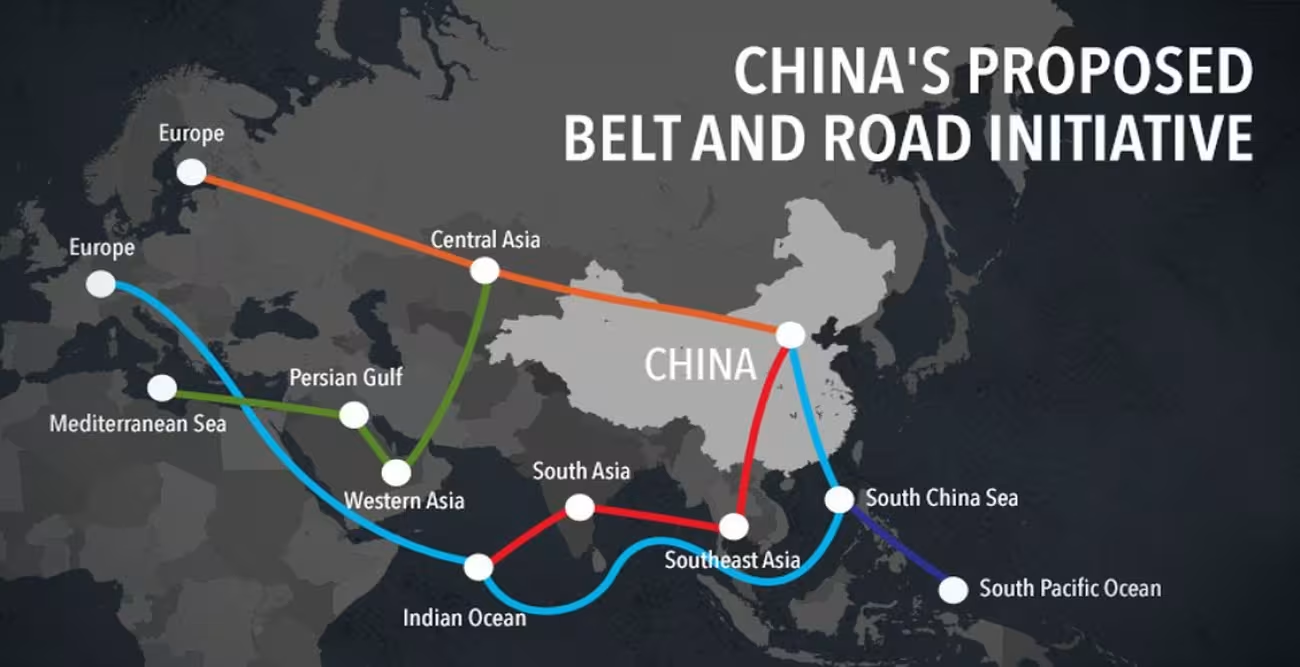
China's Belt and Road Initiative (BRI) is a global infrastructure and investment strategy launched by President Xi Jinping in 2013 to strengthen trade connections and economic cooperation across Asia, Africa, Europe and other regions. The initiative supports transportation networks, energy projects, industrial development and digital infrastructure. By June 2026, cumulative Chinese investment and construction engagement associated with the BRI had reached approximately $1.54 trillion, according to the Green Finance & Development Center. Despite its economic potential, the initiative continues to face scrutiny over debt sustainability, project transparency, environmental risks and geopolitical influence.
What Is the Belt and Road Initiative?
The Belt and Road Initiative, initially called One Belt, One Road, seeks to improve connectivity between China and international markets through infrastructure development and economic partnerships.
Its original framework consists of two major components:
- Silk Road Economic Belt: Overland trade corridors linking China with Central Asia, Europe and neighboring regions through railways, highways, pipelines and logistics facilities.
- 21st Century Maritime Silk Road: Maritime connections linking Chinese ports with Southeast Asia, South Asia, the Middle East, Africa and Europe.
The BRI has expanded beyond transportation into electricity generation, telecommunications, manufacturing, mining and renewable energy.
By the end of 2025, approximately 150 countries were included in the Green Finance & Development Center's list of active BRI partners. Participation generally involves cooperation agreements rather than membership in a single international organization.
What Are China's Main Goals?
Expanding Trade and Market Access
One of China's main objectives is to improve transportation infrastructure and reduce the cost of international trade. Better roads, railways, ports and logistics networks can help businesses reach overseas markets more efficiently.
The initiative also creates commercial opportunities for Chinese construction companies, manufacturers and technology providers.
Strengthening Energy and Resource Security
China's industrial economy depends heavily on imported energy and raw materials. Through overseas investment in energy facilities, mining operations and processing infrastructure, the BRI helps Chinese businesses secure access to important resources.
These investments increasingly include metals and minerals used in batteries, electric vehicles and electrical infrastructure.
Increasing International Economic Influence
The BRI strengthens China's relationships with participating countries through infrastructure financing, investment and long-term commercial cooperation.
Supporters emphasize the development opportunities created by these partnerships, while critics question whether financial dependence and control over strategic infrastructure could increase Beijing's political influence.
Major Belt and Road Infrastructure Projects
Several projects illustrate the initiative's scale and geographical reach.
China-Pakistan Economic Corridor
The China-Pakistan Economic Corridor (CPEC) includes transport infrastructure, power generation, industrial development and Gwadar Port. It is one of the BRI's most prominent economic corridors, although progress has been affected by security problems, financial constraints and project delays.
China-Laos Railway
Opened in December 2021, the China-Laos Railway connects Kunming in China's Yunnan province with Vientiane, Laos. It provides landlocked Laos with improved access to Chinese and regional transportation networks, supporting passenger travel and cross-border freight.
Jakarta-Bandung High-Speed Railway
Indonesia's Jakarta-Bandung high-speed railway, known as Whoosh, began commercial operations in October 2023. Developed through cooperation between Indonesian and Chinese companies, it significantly shortened travel time between the Jakarta area and Bandung.
However, its construction costs and financing arrangements have also raised questions about long-term financial sustainability.
Economic Impact of the Belt and Road Initiative
The BRI has the potential to improve trade efficiency, attract investment and support economic development in countries with inadequate infrastructure.
A World Bank study published in 2019 estimated that improvements associated with BRI transport corridors could increase trade by 2.8% to 9.7% among corridor economies and by 1.7% to 6.2% globally.
The study also projected that better connectivity, combined with appropriate policy reforms, could help lift approximately 7.6 million people out of extreme poverty and 32 million out of moderate poverty.
These figures are modeled estimates rather than measured results. Actual economic benefits depend on project costs, market demand, domestic policies and the ability of participating countries to use infrastructure productively.
Latest Belt and Road Investment Data in 2026
Chinese engagement in the BRI reached its highest first-half level on record during January-June 2026, according to research released by the Green Finance & Development Center on July 26, 2026.
The report identified approximately $49.8 billion in investment and $76.5 billion in construction contracts, representing combined engagement of around $126 billion.
Cumulative engagement since 2013 reached approximately $1.539 trillion, comprising $926 billion in construction contracts and $614 billion in investments.
These amounts represent recorded investment deals and construction engagements, not total government lending or funds already disbursed. The figures also depend on the research organization's project classifications and data collection methodology.
Energy and Mining Lead Recent Activity
Energy-related engagement reached approximately $36.3 billion in the first half of 2026, with green energy accounting for 56% of the total.
More than $20 billion was associated with green energy projects, including investments and construction commitments involving over 20 gigawatts of planned electricity-generating capacity.
Meanwhile, metals and mining engagement reached approximately $21.8 billion, with substantial activity in mineral processing and industrial manufacturing.
Technology and manufacturing investments also expanded, reflecting growing interest in batteries, industrial facilities and emerging energy technologies.
Key Challenges Facing the Belt and Road Initiative
Debt Sustainability
Large infrastructure projects frequently require substantial borrowing. When projected economic returns fail to materialize, repayment obligations can place pressure on public finances.
AidData estimates that developing countries face approximately $80 billion in debt-service payments to Chinese state-owned creditors in 2026. This figure covers broader Chinese official-sector lending and should not be interpreted as exclusively BRI-related debt.
Financial risks can become more severe when projects experience cost overruns, exchange-rate fluctuations or insufficient commercial demand.
Transparency and Governance
Some BRI financing agreements and procurement arrangements have been criticized for limited public disclosure.
Insufficient transparency can complicate assessments of project costs, contractual obligations and long-term financial exposure. Stronger procurement standards and independent feasibility studies are therefore important for protecting participating countries' economic interests.
Environmental Concerns
Infrastructure construction, mining and energy development can create environmental challenges, including habitat destruction, pollution and greenhouse gas emissions.
Although renewable energy investment has expanded, Chinese companies continue to participate in fossil fuel projects. The BRI's environmental impact consequently varies considerably between countries and sectors.
Geopolitical Tensions
The initiative has become an important subject of international competition as governments evaluate the strategic implications of Chinese investment in ports, transportation networks and critical infrastructure.
Italy announced its withdrawal from the BRI in December 2023 after concluding that the agreement had not delivered sufficient economic benefits. The decision illustrated how participating countries may reassess cooperation according to changing political and economic priorities.
How China's Belt and Road Strategy Is Evolving
Since its launch, the BRI has expanded from traditional transport infrastructure toward a broader range of commercial and industrial investments.
Recent developments show increased Chinese involvement in renewable energy, battery technology, mineral processing and overseas manufacturing.
Private enterprises are also assuming a larger role. According to the Green Finance & Development Center, privately owned Chinese companies accounted for approximately 48% of total BRI engagement by value in the first half of 2026, compared with about 13% in 2020.
Nevertheless, large infrastructure contracts remain central to the initiative. The average size of major construction engagements increased substantially in 2026, demonstrating that the BRI has not abandoned large-scale development projects.
Future Outlook
China's Belt and Road Initiative is expected to remain a major instrument of international economic cooperation, particularly in energy, transportation, manufacturing and critical minerals.
Its future direction will depend on financing conditions, geopolitical relationships, host-country development priorities and the commercial performance of existing projects.
For participating countries, the most important consideration is whether infrastructure and investment agreements generate lasting economic benefits without creating unsustainable financial or environmental costs.
More than a decade after its launch, the BRI has established an extensive international investment network. Its long-term significance will depend less on the total value of announced projects than on their ability to improve connectivity, strengthen local economies and deliver sustainable development.
- Log in to post comments