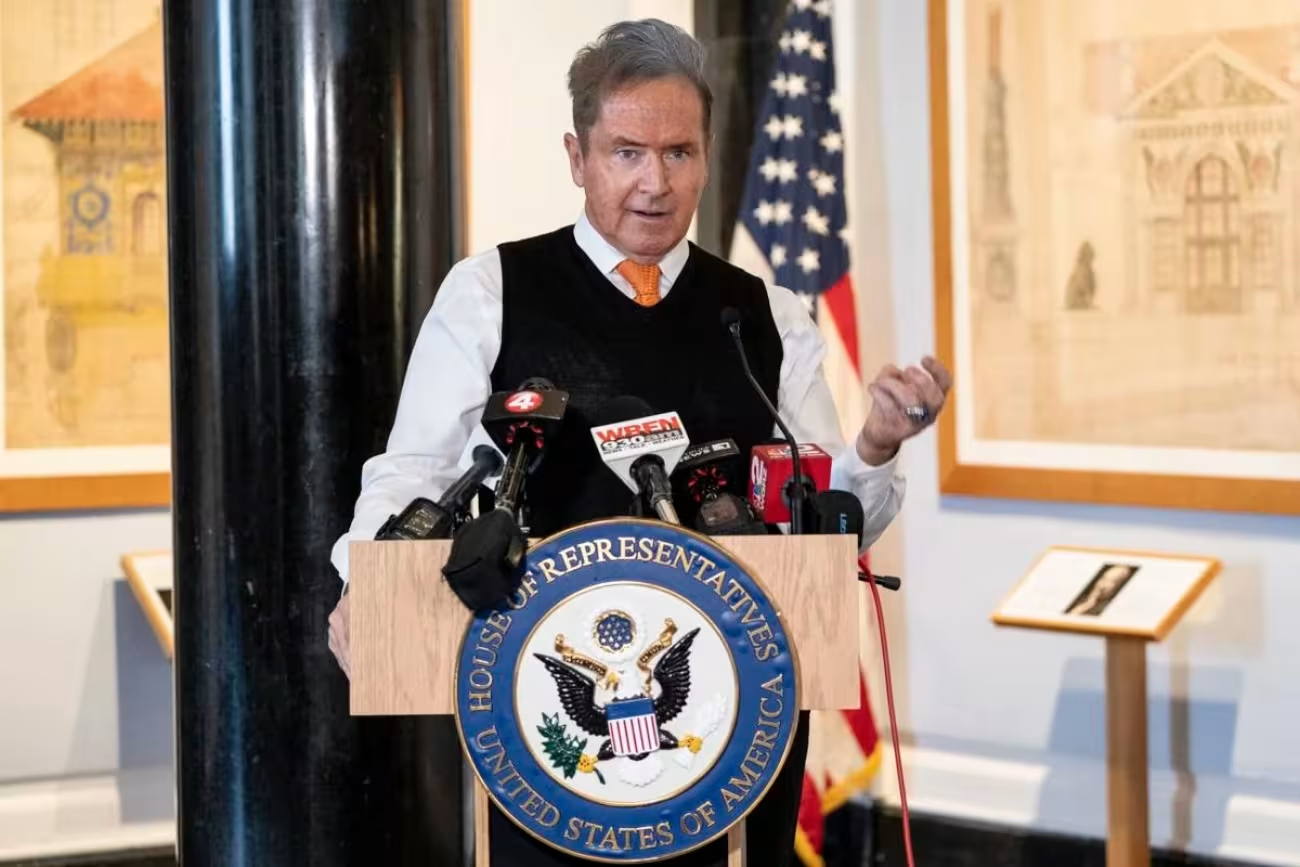
Brian Higgins is an American Democratic politician and former member of the U.S. House of Representatives who represented New York for nearly two decades. Known for his advocacy on healthcare, infrastructure, economic development and cancer research, Higgins built a political career centered on the interests of Buffalo and Western New York.
Born and raised in Buffalo, Higgins entered public service through local government before serving in the New York State Assembly and eventually Congress. He represented New York's 27th Congressional District from 2005 to 2013 and the 26th Congressional District from 2013 until February 2024.
His congressional career included several notable accomplishments, particularly efforts to transform Buffalo's waterfront, strengthen federal support for cancer research and promote economic development in Western New York. However, his political record also attracted scrutiny over delayed financial disclosures involving stock transactions in 2021.
In February 2024, Higgins left Congress before the end of his term and became president and CEO of Shea's Performing Arts Center in Buffalo. His departure reflected growing frustration with the increasingly dysfunctional environment in Washington and a decision to pursue a leadership role in a major cultural institution.
By November 2026, Higgins had established a new professional profile outside electoral politics. He was leading Shea's through a major expansion project and serving on the board of Roswell Park Comprehensive Cancer Center, maintaining connections with healthcare, economic development and regional civic leadership.
Who Is Brian Higgins?
Brian Michael Higgins was born on October 6, 1959, in Buffalo, New York. He grew up in South Buffalo, a working-class neighborhood with a strong Irish-American cultural identity.
His early political involvement developed through local community affairs. Before entering Congress, he served on the Buffalo Common Council and represented the 145th District in the New York State Assembly.
Higgins is a member of the Democratic Party and became particularly associated with policies designed to improve economic conditions in Western New York.
Education and Early Career
Higgins attended Buffalo State College, where he earned undergraduate and graduate degrees.
He subsequently obtained a Master of Public Administration from Harvard University's John F. Kennedy School of Government.
His professional background included public administration, legislative work and teaching. He also served as chief of staff for the Erie County Legislature and worked as an adjunct instructor at Buffalo State College.
These experiences helped establish his political career at the local and state levels before his election to Congress.
Brian Higgins' Political Career Before Congress
Higgins began his elected political career as a member of the Buffalo Common Council, serving from 1988 to 1993.
His work focused on local development, neighborhood issues and the economic challenges facing Buffalo.
In 1999, he entered the New York State Assembly, representing the 145th District until 2004.
His experience in local and state government provided a foundation for his subsequent campaign for the U.S. House of Representatives.
Election to the U.S. House of Representatives in 2004
Higgins was elected to Congress in 2004 and began serving in January 2005.
He initially represented New York's 27th Congressional District. Following congressional redistricting, he represented the 26th District beginning in 2013.
His district included Buffalo, Niagara Falls and surrounding communities in Western New York.
He remained in Congress until February 2, 2024, completing almost 19 years of federal legislative service.
Political Priorities
Throughout his congressional career, Higgins emphasized several major policy areas:
- Healthcare access and medical research funding.
- Economic development and infrastructure investment.
- Manufacturing and industrial competitiveness.
- Transportation and regional connectivity.
- Tourism, cultural institutions and waterfront revitalization.
- Support for working families and community development.
His political approach was strongly influenced by the economic needs of Buffalo and surrounding communities, which had experienced decades of industrial restructuring and population changes.
Major Congressional Achievement: Buffalo Waterfront Revitalization
One of Higgins's most frequently cited achievements was his involvement in transforming Buffalo's waterfront.
For many years, the waterfront had been affected by industrial decline, underused land and limited public access.
Higgins supported federal investment and regional cooperation to convert parts of the waterfront into public parks, recreational areas, trails and transportation corridors.
According to Roswell Park's 2025 biography of Higgins, one of his major accomplishments was helping secure approximately $400 million for the transformation of Buffalo's waterfront.
The investment contributed to a wider revitalization strategy designed to attract residents, visitors and businesses.
Economic Importance of the Waterfront
Waterfront redevelopment is important because it can generate economic benefits beyond the construction phase.
Improved public spaces can increase tourism, encourage private investment and strengthen nearby restaurants, hotels and retail businesses.
For Buffalo, the project also represented an opportunity to reposition the city as a destination for recreation, culture and tourism rather than relying primarily on its industrial past.
Brian Higgins and Cancer Research Funding
Another major area of Higgins's congressional work was healthcare, particularly federal support for cancer research.
He served as a co-chair of the Congressional Cancer Caucus and participated in the Childhood Cancer Caucus.
His advocacy focused on improving access to medical research, strengthening clinical trials and supporting patients who needed advanced treatment options.
The Cancer Drug Parity Act
Higgins was the lead cosponsor of the Increasing Access to Cancer Treatment Act, commonly referred to as the Cancer Drug Parity Act.
The legislation sought to address differences in insurance coverage between oral cancer medications and traditional intravenous treatments.
Under many insurance arrangements, patients taking oral cancer medications could face higher out-of-pocket costs than those receiving medications administered in clinical settings.
The proposed legislation aimed to reduce these differences and improve access to treatment.
Lung Cancer Screening
Higgins also supported the Increasing Access to Lung Cancer Screening Act.
The initiative focused on improving access to early detection services, particularly for individuals at higher risk of developing lung cancer.
His work reflected a broader commitment to prevention, research funding and reducing financial barriers to healthcare.
Financial Disclosure Controversy: Delayed Stock Transaction Reporting
Although Higgins's congressional career included significant legislative achievements, his financial disclosure practices attracted criticism.
In 2021, reporting by local media revealed that Higgins had failed to disclose several stock transactions within the legally required reporting period.
The transactions involved three stock trades that were reportedly disclosed approximately 11 months after they occurred.
The issue attracted attention because members of Congress are required to report certain financial transactions under the Stop Trading on Congressional Knowledge Act, commonly known as the STOCK Act.
What Is the STOCK Act?
The STOCK Act, enacted in 2012, was designed to strengthen transparency and prevent members of Congress and other government officials from using nonpublic information for personal financial gain.
Among its requirements, the law requires covered officials to report certain stock and securities transactions within 45 days of the transaction.
The reporting obligation is intended to make financial activities more transparent and allow the public to identify potential conflicts of interest.
What Happened With Higgins's Disclosures?
According to local reporting, Higgins acknowledged that he had made errors in his financial disclosures and said he would pay any applicable penalty.
The issue concerned delayed reporting rather than a proven case of insider trading.
There is no basis for treating the late disclosures alone as proof that Higgins used confidential congressional information to profit from securities transactions.
The controversy nevertheless raised questions about the consistency of financial reporting requirements and the accountability of elected officials.
Why Financial Transparency Matters for Members of Congress
Members of Congress have access to confidential policy discussions, legislative information and government briefings that may affect businesses and financial markets.
For this reason, financial disclosure requirements are important safeguards against conflicts of interest and the appearance of improper trading.
Even when a reporting violation does not establish insider trading, delayed disclosures can undermine public confidence in political institutions.
The Higgins episode illustrates the distinction between a failure to meet disclosure deadlines and evidence of an actual securities offense.
Why Brian Higgins Left Congress in 2024
In November 2023, Higgins announced that he intended to leave Congress in early 2024.
He expressed frustration with the increasingly dysfunctional nature of the institution and the difficulty of making meaningful legislative progress.
He described Washington as a place where lawmakers were spending more time doing less and where the institution was no longer serving the American public as effectively as it once had.
His comments reflected concerns shared by several lawmakers about political polarization, legislative gridlock and the growing difficulty of bipartisan cooperation.
Resignation on February 2, 2024
Higgins officially resigned from the House of Representatives on February 2, 2024.
His departure ended nearly 19 years of congressional service.
He was succeeded by Democrat Timothy Kennedy, who won a special election on April 30, 2024, to fill the vacant seat.
Kennedy subsequently continued representing New York's 26th Congressional District.
Brian Higgins Becomes President and CEO of Shea's Performing Arts Center
Before leaving Congress, Higgins had accepted a new leadership position at Shea's Performing Arts Center in Buffalo.
He officially became the institution's president and CEO on February 5, 2024.
Shea's Performing Arts Center is one of the most prominent cultural institutions in Western New York.
Its historic Buffalo Theatre opened in 1926 and became a major venue for Broadway productions, concerts and other performing arts events.
The organization operates a three-theatre campus and welcomes more than 350,000 patrons annually.
Why the Transition Was Significant
Higgins's move from Congress to Shea's represented a transition from electoral politics to cultural and institutional leadership.
His experience with federal funding, public-private partnerships, economic development and regional infrastructure offered a different set of skills for managing a major performing arts organization.
The position also allowed him to remain involved in Buffalo's economic development without holding elected office.
Shea's Performing Arts Center: The $34.6 Million Expansion Project
One of the major developments under Higgins's leadership is the expansion of Shea's Buffalo Theatre.
On March 16, 2026, New York Governor Kathy Hochul announced the start of construction on a $34.6 million expansion project.
The project is designed to modernize the historic venue while improving accessibility and the experience of visitors.
What the Expansion Includes
The project involves a new four-story addition covering approximately 25,600 square feet.
Planned improvements include:
- A new box office.
- Expanded lobby and event spaces.
- Additional concessions on each level.
- More public restrooms.
- Three new elevators.
- An outdoor patio.
- Improved accessibility for visitors with mobility limitations.
- Additional space for audiences before and after performances.
Government Funding and Investment
The expansion reflects a combination of state and local support.
New York State announced an $18.5 million investment, including funding from several public agencies.
The New York Power Authority committed $7.5 million, while the New York State Council on the Arts and the Dormitory Authority of the State of New York each contributed $5 million through separate grants. Empire State Development also provided $1 million.
The project received an additional $5 million state capital commitment announced alongside the construction launch.
The City of Buffalo had also committed $4.6 million for roof-system replacement at the historic theatre.
The expansion is expected to be completed by the end of 2027.
The Economic Impact on Buffalo
The investment demonstrates how cultural institutions can contribute to regional economic development.
Large performing arts venues attract visitors who spend money on accommodation, restaurants, transportation and other local services.
Construction also supports employment and creates opportunities for contractors, suppliers and local businesses.
For downtown Buffalo, the Shea's expansion forms part of a wider strategy to strengthen the city's cultural district and attract more visitors.
Brian Higgins Joins the Roswell Park Board of Directors
On December 16, 2025, Roswell Park Comprehensive Cancer Center announced that Higgins had been appointed to its board of directors.
The appointment was made by Andrea Stewart-Cousins, the president and majority leader of the New York State Senate, to fill a board vacancy.
The position reflects his long-standing involvement in cancer research policy during his congressional career.
Roswell Park is a major cancer research and treatment institution based in Buffalo.
As a member of its board, Higgins brings experience in federal policy, institutional fundraising and public-sector partnerships.
His appointment also demonstrates that his influence in regional healthcare and civic affairs has continued after leaving Congress.
Brian Higgins's Other Civic and Institutional Roles
Beyond Shea's and Roswell Park, Higgins has maintained involvement in several regional institutions.
His reported board affiliations include:
- Daemen University.
- Buffalo Place.
- New York State Council on the Arts.
- Roswell Park Comprehensive Cancer Center.
These roles connect him to education, healthcare, arts administration and downtown economic development.
His post-congressional career is therefore not simply a move into theatre management. It represents a broader continuation of his regional civic engagement.
Political Legacy: What Brian Higgins Leaves Behind
Higgins's political legacy is closely connected to Buffalo and Western New York.
His supporters point to his work on waterfront redevelopment, federal infrastructure investment, cancer research funding and economic development.
These initiatives helped strengthen his reputation as a regional advocate who focused on tangible improvements to his constituency.
However, his legacy also includes questions about political accountability, including the delayed financial disclosures that attracted criticism in 2021.
His resignation in 2024 also reflected a broader problem facing American politics: increasing polarization and declining confidence in Congress as an effective legislative institution.
A Shift From Federal Politics to Regional Leadership
Higgins's transition to Shea's Performing Arts Center illustrates a different way for former elected officials to remain influential in public life.
Instead of pursuing another elected position, he moved into the leadership of a major nonprofit cultural institution.
His experience in securing public funding and building relationships with government officials has become relevant to Shea's expansion and long-term development strategy.
The appointment to Roswell Park's board further reinforces this transition into regional institutional leadership.
Brian Higgins: Career Timeline
| Year | Career Development |
|---|---|
| 1959 | Born in Buffalo, New York. |
| 1988–1993 | Served on the Buffalo Common Council. |
| 1999–2004 | Represented the 145th District in the New York State Assembly. |
| 2005 | Entered the U.S. House of Representatives representing New York's 27th District. |
| 2012 | New congressional district boundaries changed his constituency to New York's 26th District. |
| 2021 | Financial disclosure delays involving three stock transactions attracted public scrutiny. |
| November 2023 | Announced plans to leave Congress. |
| February 2, 2024 | Resigned from the U.S. House of Representatives. |
| February 5, 2024 | Became president and CEO of Shea's Performing Arts Center. |
| April 30, 2024 | Tim Kennedy won the special election to replace him in Congress. |
| December 16, 2025 | Named to the Roswell Park Comprehensive Cancer Center Board of Directors. |
| March 16, 2026 | Shea's $34.6 million expansion project officially entered construction. |
| August 17, 2026 | Construction crews reached the foundation milestone for the expansion. |
| November 2026 | Continues serving as president and CEO of Shea's Performing Arts Center. |
Frequently Asked Questions
Who is Brian Higgins?
Brian Higgins is a former Democratic member of the U.S. House of Representatives from New York. He represented the 26th and 27th Congressional Districts for nearly 19 years before resigning in February 2024.
Why did Brian Higgins leave Congress?
He expressed frustration with political polarization, legislative gridlock and the declining effectiveness of Congress. He subsequently accepted a leadership position at Shea's Performing Arts Center.
What does Brian Higgins do now?
As of November 2026, he serves as president and CEO of Shea's Performing Arts Center in Buffalo. He also serves on the board of Roswell Park Comprehensive Cancer Center and other regional institutions.
Was Brian Higgins involved in an insider-trading scandal?
He faced scrutiny over delayed reporting of three stock transactions in 2021. The issue involved financial disclosure compliance. The available reporting does not establish that he engaged in proven insider trading.
What is the STOCK Act?
The STOCK Act is a federal law enacted in 2012 that strengthens financial transparency requirements for members of Congress and other government officials, including reporting certain stock transactions within 45 days.
Who replaced Brian Higgins in Congress?
Democrat Timothy Kennedy won the April 30, 2024, special election to replace Higgins in New York's 26th Congressional District.
What is Shea's Performing Arts Center?
Shea's Performing Arts Center is a historic cultural institution in Buffalo, New York. It operates three theatres and presents Broadway productions, concerts, comedy, educational programs and other performing arts events.
How much is the Shea's Buffalo Theatre expansion project worth?
New York State announced a $34.6 million expansion project in March 2026, with additional public funding commitments. The project is expected to be completed by the end of 2027.
Is Brian Higgins still involved in healthcare policy?
Although he is no longer a member of Congress, he continues to participate in healthcare-related institutional leadership through his appointment to the Roswell Park Comprehensive Cancer Center Board of Directors.
Conclusion: Brian Higgins's Transition From Washington Politics to Buffalo's Cultural Leadership
Brian Higgins built a nearly two-decade career in Congress representing the interests of Buffalo and Western New York. His legislative work focused on regional economic development, infrastructure, healthcare and cancer research.
His career was not without controversy. Delayed financial disclosures involving stock transactions in 2021 raised questions about transparency and compliance with congressional reporting requirements. However, those reporting issues should not be mischaracterized as proof of insider trading.
His resignation from Congress in February 2024 marked a significant transition. By becoming president and CEO of Shea's Performing Arts Center, Higgins moved from federal policymaking into the management of one of Buffalo's most important cultural institutions.
His leadership now includes overseeing a major theatre expansion supported by public investment and strengthening the organization's contribution to downtown Buffalo's economy.
His appointment to the Roswell Park board also demonstrates the continuation of his involvement in healthcare and regional development.
As of November 2026, Brian Higgins's public role is defined less by electoral politics and more by institutional leadership, cultural investment and civic development in Western New York.
```
- Log in to post comments