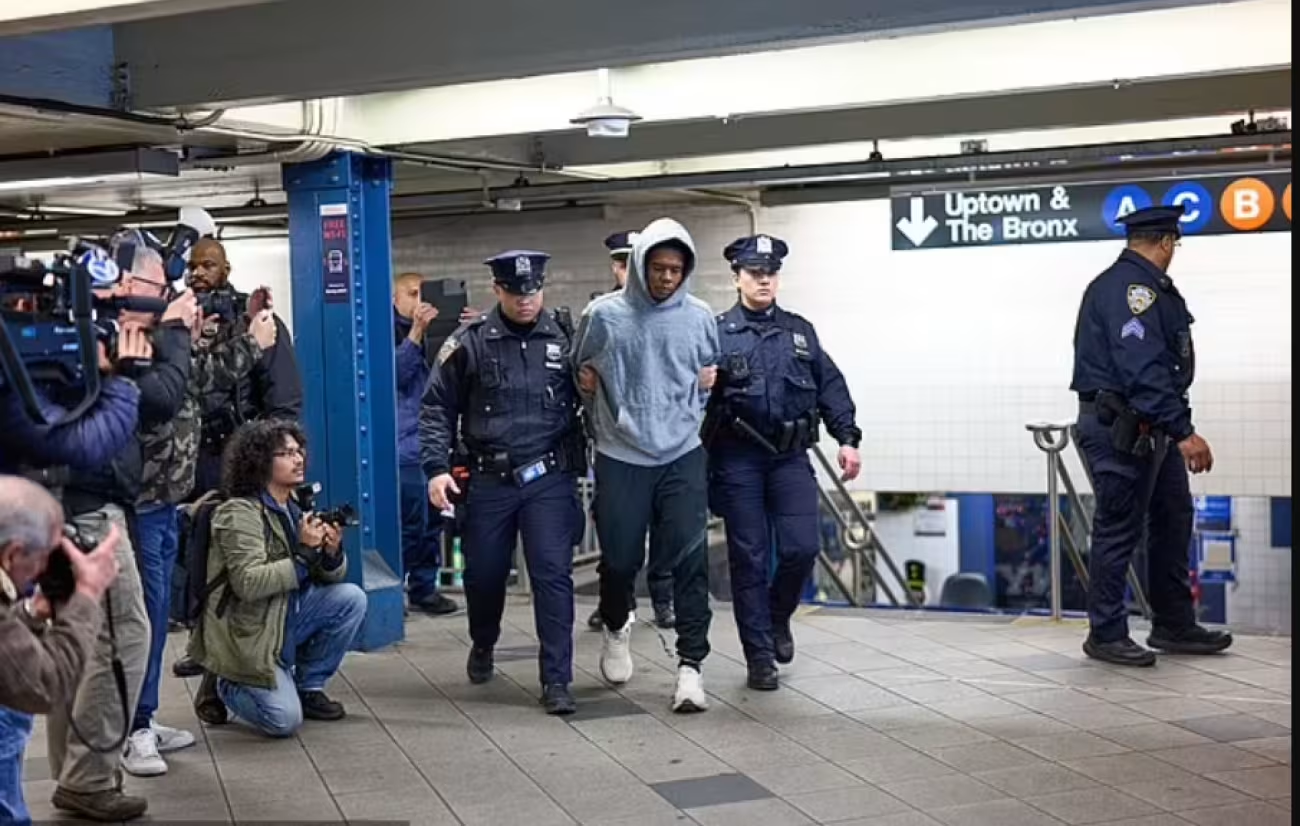
Kamel Hawkins, a Brooklyn man accused of pushing a stranger in front of an approaching New York City subway train, faces attempted murder and assault charges following a violent attack at Manhattan's 18th Street station on December 31, 2024. The victim, 45-year-old Joseph Lynskey, survived after falling into the path of a southbound No. 1 train but sustained multiple serious injuries, including a fractured skull, four broken ribs, and a ruptured spleen.
The incident shocked New York commuters after surveillance footage showed the sudden attack on a crowded public transportation system. Hawkins was arrested less than an hour later and subsequently indicted on additional felony charges. He pleaded not guilty in January 2025.
The case also developed into a broader debate about subway security and the responsibility of transit authorities to protect passengers. In February 2026, Lynskey filed a separate civil lawsuit against New York City and the Metropolitan Transportation Authority (MTA), alleging that inadequate platform safety measures contributed to the risks faced by subway riders.
What Happened in the Kamel Hawkins Subway Attack?
The attack occurred at approximately 1:30 p.m. on New Year's Eve, December 31, 2024, at the 18th Street station in Manhattan's Chelsea neighborhood.
Joseph Lynskey was standing on the downtown platform waiting for a train when Hawkins allegedly approached him from behind. According to prosecutors, Hawkins suddenly pushed Lynskey onto the tracks just as a southbound No. 1 train entered the station.
Surveillance footage captured the incident, showing the suspect approaching the unsuspecting passenger before shoving him off the platform. The train struck Lynskey as it entered the station.
Emergency responders rushed to the scene and worked to rescue the injured passenger from beneath the train. Lynskey was subsequently transported to Bellevue Hospital in Manhattan.
Police described the incident as an apparently unprovoked attack. Investigators did not initially identify any known relationship between Hawkins and the victim.
Who Is Kamel Hawkins?
Kamel Hawkins was identified by New York authorities as a 23-year-old Brooklyn resident at the time of the incident.
He became the focus of a police investigation after surveillance footage showed a man pushing a subway passenger onto the tracks. Authorities used the available video evidence and a description of the suspect to locate him.
Hawkins was arrested at the 59th Street-Columbus Circle subway station less than an hour after the attack, according to police reporting.
Media reports also documented previous arrests involving Hawkins. However, prior arrests and allegations are separate matters and should not be treated as proof of guilt in the subway attack.
Joseph Lynskey's Serious Injuries and Survival
Joseph Lynskey survived the encounter but suffered extensive injuries that required hospitalization and a prolonged recovery.
According to court records and subsequent interviews, his injuries included:
- Four broken ribs.
- A fractured skull.
- A ruptured spleen.
- A concussion.
Lynskey later explained that he believed he was going to die when he realized he had been pushed into the path of the approaching train.
One particularly important factor in his survival was where he fell relative to the train and the tracks. He remained still after falling, aware of the danger posed by the electrified third rail.
Firefighters and emergency personnel eventually reached him and helped pull him to safety.
He spent several days in intensive care and continued recovering through medical treatment and physical therapy.
How Kamel Hawkins Was Arrested
Following the incident, the NYPD launched an investigation using surveillance footage and information from the scene.
Hawkins was located at the 59th Street-Columbus Circle station and arrested later on December 31, 2024.
Authorities subsequently connected him to the attack and initiated criminal proceedings in Manhattan.
The rapid arrest highlighted the role of surveillance cameras and coordination between police officers and transit authorities in investigating violent incidents across the subway network.
Criminal Charges Against Kamel Hawkins
On January 22, 2025, a Manhattan grand jury indicted Hawkins in connection with the subway attack.
The charges reported by prosecutors included:
- Attempted murder in the second degree: Alleging that Hawkins attempted to cause Lynskey's death.
- Attempted assault in the first degree: Relating to the alleged attempt to inflict serious physical injury.
- Assault in the second degree: Relating to the serious injuries allegedly caused during the incident.
Hawkins pleaded not guilty to the charges. He was held in custody pending further proceedings following his arraignment.
It is important to distinguish between an indictment and a conviction. The charges represent the prosecution's allegations, and Hawkins is presumed innocent unless proven guilty in court.
Joseph Lynskey Speaks About His Near-Death Experience
In January 2025, Lynskey spoke publicly about the incident in interviews with ABC News and other media outlets.
He described the terrifying moment when he realized he had been pushed onto the tracks and an approaching train was heading toward him.
Despite the physical and emotional consequences, Lynskey expressed his intention to continue using public transportation rather than allowing the attack to permanently restrict his independence.
His recovery also attracted considerable public support. The incident prompted renewed discussion about the vulnerability of passengers waiting near subway platform edges.
Joseph Lynskey Sues New York City and the MTA
On February 25, 2026, more than a year after the attack, Lynskey filed a civil lawsuit against New York City and the Metropolitan Transportation Authority.
The lawsuit alleged that the city and transit agency had failed to implement adequate safety protections despite longstanding awareness of the dangers associated with passengers being pushed onto subway tracks.
According to the complaint described in media coverage, the MTA had access to years of internal safety information indicating that passengers could suffer serious injuries or death in platform-edge incidents.
The lawsuit challenged the agency's approach to platform protection, including its reliance on fixed barriers at selected stations rather than installing comprehensive platform screen doors.
Platform screen doors are physical barriers designed to separate passengers from active railway tracks. They can reduce the possibility of accidental falls and deliberate pushing incidents.
However, the MTA has previously argued that full platform doors are physically difficult to install at many existing New York subway stations because of differences in platform configurations, train designs, and infrastructure requirements.
Lynskey's lawsuit seeks accountability for alleged negligence and failures in passenger safety. These claims remain allegations within a separate civil proceeding and should not be confused with the criminal charges against Hawkins.
Why Platform Screen Doors Matter in Subway Safety
The attack on Lynskey highlighted a fundamental weakness in many traditional subway systems: passengers often wait only a short distance from moving trains without a physical barrier separating them from the tracks.
Platform screen doors are increasingly used in modern metro systems around the world to reduce this exposure.
Preventing Falls and Deliberate Pushes
Physical barriers can prevent passengers from accidentally falling onto tracks and make it more difficult for someone to deliberately push another person into the path of an approaching train.
They can also help prevent unauthorized access to railway infrastructure.
Challenges for Older Subway Networks
Installing platform screen doors throughout an older transportation network is not a straightforward project.
New York's subway system includes stations built across different periods, with variations in platform layouts, train lengths, door positions, and infrastructure conditions.
These differences can require extensive engineering work and significant investment.
Nevertheless, the debate raises important questions about how transit authorities should balance infrastructure costs with passenger safety.
The Difference Between Criminal Responsibility and MTA Liability
The Kamel Hawkins case involves two separate legal questions.
The criminal proceeding concerns whether Hawkins committed the offenses alleged by prosecutors when Lynskey was pushed onto the tracks.
The civil lawsuit concerns whether New York City and the MTA failed to take reasonable precautions to protect subway passengers from foreseeable dangers.
These legal proceedings involve different defendants, legal standards, and potential outcomes.
Even if the criminal prosecution establishes individual responsibility for the attack, that would not automatically determine whether the city or MTA bears civil liability for alleged infrastructure or safety failures.
Likewise, filing a civil lawsuit does not establish that the transit agency was legally negligent. That question must be resolved through the civil litigation process.
Where Does the Kamel Hawkins Case Stand?
As of November 5, 2026, the sources reviewed for this article confirm Hawkins' January 2025 indictment and not-guilty plea. They also confirm that Lynskey initiated a separate civil lawsuit against New York City and the MTA in February 2026.
A subsequent criminal trial verdict or sentencing decision could not be independently verified from the available reporting. Therefore, Hawkins should continue to be described as an accused defendant rather than a convicted offender.
The civil lawsuit has also brought attention to the broader question of whether New York's subway infrastructure provides sufficient protection against dangerous platform incidents.
Conclusion
The subway attack involving Kamel Hawkins and Joseph Lynskey demonstrates how quickly an ordinary commute can turn into a life-threatening emergency.
Lynskey survived after being pushed onto the tracks in front of an approaching train, but his serious injuries and extended recovery underscored the lasting consequences of the incident.
The criminal charges against Hawkins address the alleged individual act of violence, while Lynskey's lawsuit against New York City and the MTA raises a separate question about institutional responsibility for passenger safety.
Beyond the criminal proceedings, the case has become part of a wider debate about platform barriers, transit security, infrastructure investment, and the obligation to protect people who depend on public transportation every day.
```
- Log in to post comments