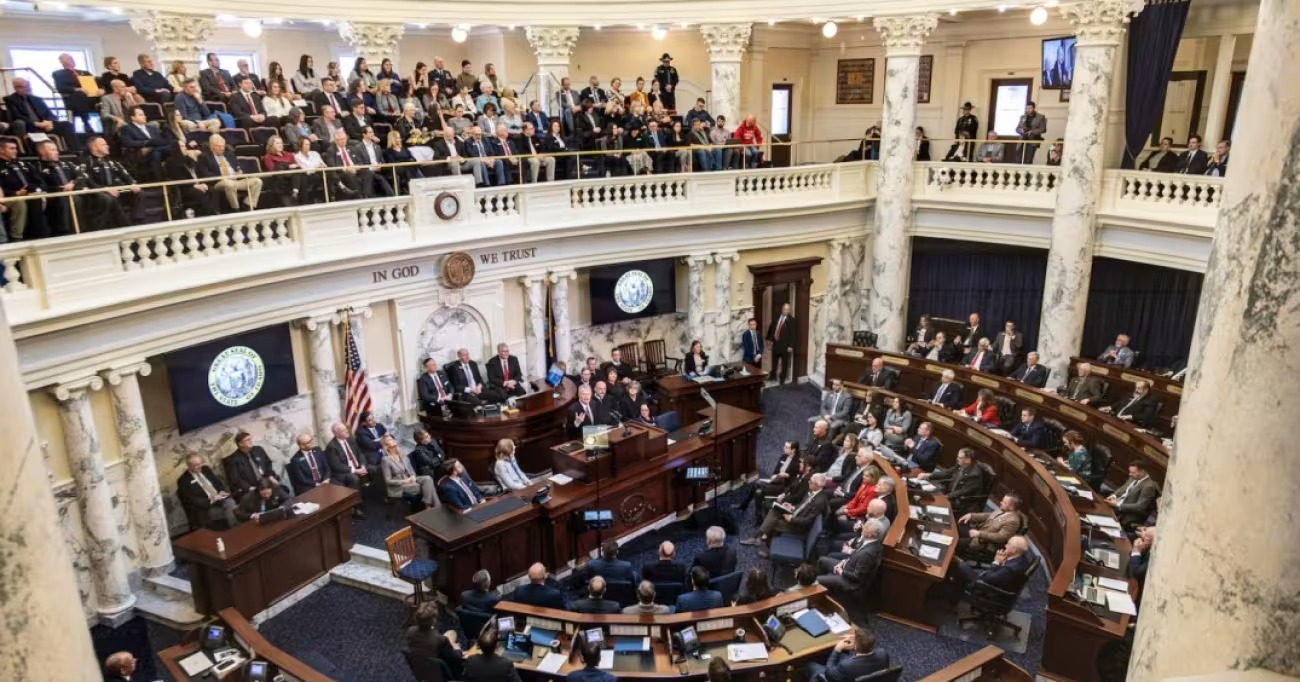
Idaho Republicans renewed their effort to challenge same-sex marriage rights in 2026, advancing a proposal that urged the U.S. Supreme Court to overturn its landmark marriage equality ruling. Although the measure passed the Idaho House of Representatives, it failed to advance through the state Senate.
The proposal, House Joint Memorial 17 (HJM 17), sought to reverse Obergefell v. Hodges, the 2015 Supreme Court decision establishing a nationwide constitutional right to same-sex marriage.
The effort attracted attention because it came amid continued legal and political disagreements over LGBTQ rights. However, the proposal did not change marriage laws, and same-sex marriage remains legal throughout the United States.
What Happened to Idaho's Same-Sex Marriage Proposal?
Republican state Rep. Tony Wisniewski of Post Falls sponsored HJM 17, which was formally introduced on February 24, 2026.
The memorial called on the Supreme Court to reverse Obergefell v. Hodges and restore a definition of marriage limited to one man and one woman.
On March 10, the Idaho House approved the measure by a 44-26 vote. Seventeen Republicans joined Democratic lawmakers in voting against it, demonstrating divisions within the Republican-controlled chamber.
The proposal reached the Senate on March 11 and was referred to the Senate State Affairs Committee. It received no further approval before Idaho's legislative session ended on April 2, 2026.
Legislative tracking records subsequently classified HJM 17 as dead in committee. The ACLU of Idaho also confirmed that the measure had failed.
Why Idaho Republicans Wanted to Reverse Obergefell
Supporters of HJM 17 argued that decisions about marriage should primarily belong to individual states rather than the federal judiciary.
Wisniewski presented the proposal as an issue of state authority and traditional marriage. During legislative discussions, he emphasized his view that marriage and family existed before government institutions.
The memorial reflected a broader conservative legal argument that the Supreme Court's 2015 marriage equality decision exceeded the judiciary's constitutional authority.
Opponents challenged that interpretation, maintaining that constitutional protections should apply equally to same-sex couples regardless of where they live.
Some Republican lawmakers also questioned the use of religious arguments to justify changes to civil marriage law. The opposition within the Idaho House highlighted disagreements over the relationship between religious beliefs and government policy.
How Obergefell v. Hodges Established Marriage Equality
On June 26, 2015, the Supreme Court ruled 5-4 in Obergefell v. Hodges that the Fourteenth Amendment protects the right of same-sex couples to marry.
The decision required states to issue marriage licenses to eligible same-sex couples and recognize lawful same-sex marriages performed in other states.
Before the ruling, marriage laws differed across the country. Some states permitted same-sex marriage, while others maintained restrictions.
Idaho had already begun allowing same-sex marriages in October 2014 following a federal appeals court ruling. Nevertheless, Obergefell established a consistent constitutional standard nationwide.
More than a decade later, the decision remains binding Supreme Court precedent.
Supreme Court Rejected Another Marriage Equality Challenge in 2025
Idaho's 2026 proposal followed a significant Supreme Court development involving former Kentucky county clerk Kim Davis.
Davis became nationally known in 2015 after refusing to issue marriage licenses to same-sex couples because of her religious objections.
Her subsequent legal proceedings eventually reached the Supreme Court through a petition asking the justices to reconsider constitutional issues connected to Obergefell.
On November 10, 2025, the Supreme Court denied her petition for review in Davis v. Ermold, case number 25-125.
The Court provided no explanation for declining the case. Its decision left the existing marriage equality precedent unchanged.
Justice Clarence Thomas has previously called for reconsideration of Obergefell. However, his position does not represent a decision by the full Court to reverse marriage protections.
The denial of Davis's petition also does not prevent future legal challenges, although no reversal resulted from that case.
What the Respect for Marriage Act Means for LGBTQ Couples
Even if Obergefell v. Hodges were reconsidered, an additional federal law provides important protections for legally recognized marriages.
President Joe Biden signed the Respect for Marriage Act on December 13, 2022.
The legislation requires the federal government to recognize marriages between two individuals that were validly entered into under applicable law. It also generally requires states to recognize qualifying marriages performed in other states, regardless of the spouses' sex, race, ethnicity, or national origin.
However, the law does not independently require every state to issue same-sex marriage licenses if the constitutional protections established by Obergefell were overturned.
That distinction matters because some states still have older marriage restrictions in their legal codes, although those restrictions cannot currently be enforced against same-sex couples under existing Supreme Court precedent.
The Respect for Marriage Act therefore provides an additional legal safeguard, but it is not identical to the constitutional right established in 2015.
What Idaho's Failed Proposal Means for LGBTQ Rights
HJM 17 was a joint memorial, not a bill capable of changing state or federal marriage laws.
Even if both chambers of the Idaho Legislature had adopted it, the memorial would only have communicated a formal request to the Supreme Court. It could not compel the justices to reopen Obergefell.
The ACLU of Idaho opposed the measure, arguing that efforts to reverse marriage equality threatened established protections for LGBTQ couples and their families.
Supporters, meanwhile, maintained that the proposal reflected concerns about states' rights and the constitutional authority of federal courts.
Beyond the constitutional debate, marriage recognition has practical consequences involving parental relationships, inheritance, medical decisions, taxes, and government benefits.
For those reasons, potential changes to marriage law remain consequential even when legislative proposals themselves have no immediate legal effect.
Is Same-Sex Marriage Still Legal in Idaho?
Yes. As of October 23, 2026, same-sex marriage remains legal in Idaho and every other U.S. state.
The failure of HJM 17 means Idaho's 2026 Legislature did not adopt a joint memorial requesting the reversal of marriage equality. More importantly, the Supreme Court has not overturned the constitutional protections established by Obergefell v. Hodges.
Idaho officials must therefore continue issuing marriage licenses to eligible same-sex couples and recognizing legally valid marriages.
Future lawmakers may introduce similar proposals, but any actual change to nationwide constitutional marriage rights would require a separate legal development.
Conclusion
Idaho Republicans' 2026 effort to challenge same-sex marriage rights gained approval in the state House but ultimately failed in the Senate.
The proposal demonstrated that disagreements over marriage equality remain part of American politics, particularly concerning religious beliefs, state authority, and constitutional protections.
For now, the legal situation remains unchanged. Obergefell v. Hodges continues to protect same-sex marriage nationwide, while the Respect for Marriage Act provides additional federal recognition safeguards.
- Log in to post comments